
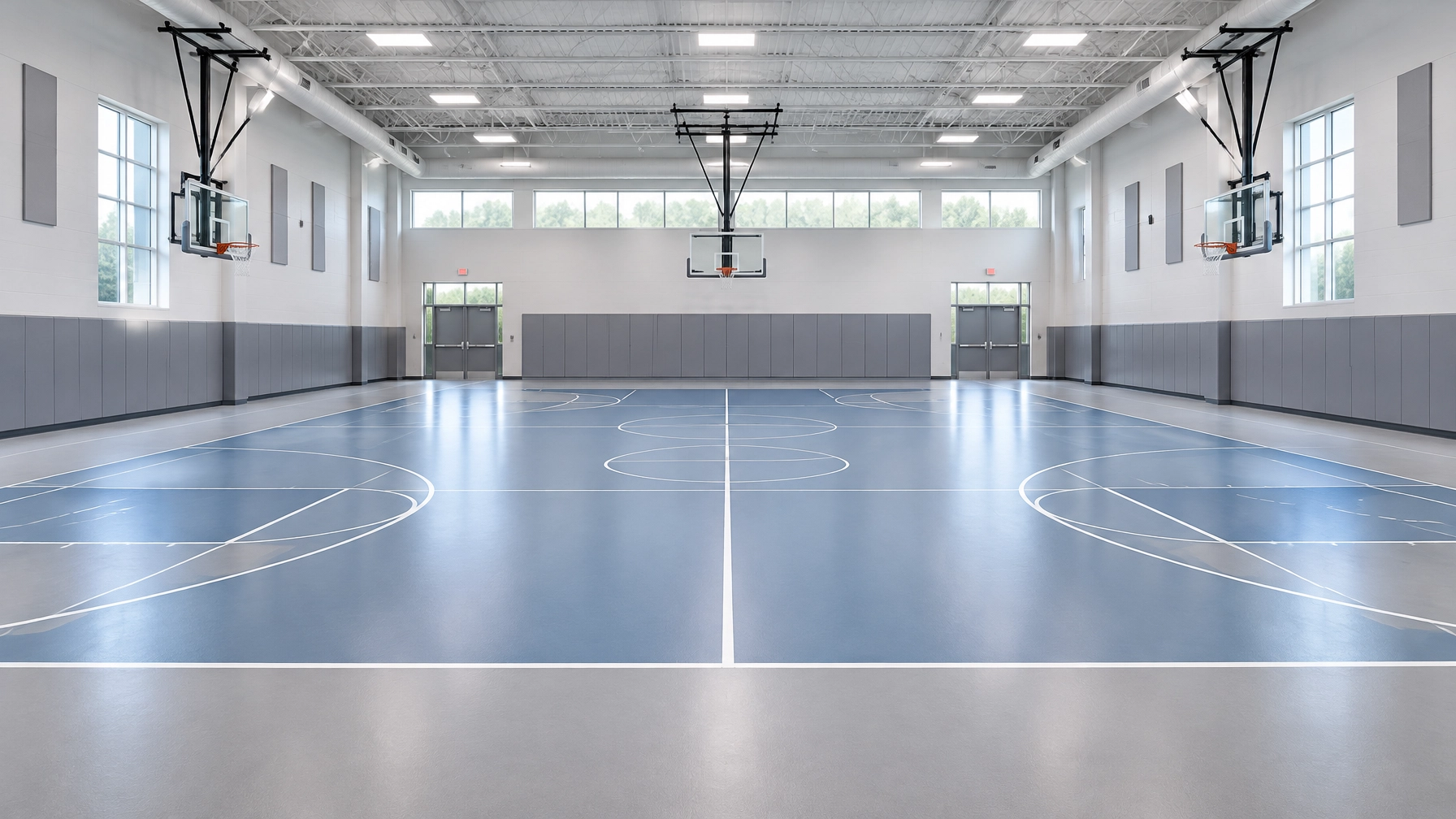
Selecting among sports flooring systems is a conversation about fit, not simply choosing a color or surface material. The right system depends on the activities it must support, who will use it, the condition of the substrate, and what happens in the space between games. A school gym used for athletics and assemblies has different demands from a strength-training room or a private home gym.
For facility managers, school administrators, gym owners, and recreation operators, the best first step is to slow down and answer the foundational questions. That work helps avoid a common outcome: a floor that looks right on day one but creates performance, maintenance, or downtime problems after turnover.
Start with the facility, not the product
Before comparing flooring products, document how the space will actually be used. A floor intended for basketball, volleyball, and community events may need to balance sport-specific performance with resistance to chairs, portable equipment, and rolling loads. A fitness room may prioritize durability, grip, and impact protection instead.
Start with these questions:
- What activities take priority? List primary sports and secondary uses, including fitness classes, assemblies, exams, or public events.
- Who will use the space? Consider athletes’ age and ability, accessibility needs, and the level of competition.
- What loads and equipment are expected? Account for bleachers, goals, weight equipment, carts, and floor-cleaning machines.
- What is the condition of the substrate? Check slab moisture, flatness, cracks, movement, old adhesives, and existing coatings.
- What maintenance can the facility support? Consider cleaning schedules, approved products, staff training, and periodic surface renewal.
- When must the space return to service? Establish shutdown windows and sequencing requirements before selecting a system.
These details inform the specification. Without them, a product comparison can focus on attractive features while missing the conditions most likely to affect performance.
Common types of sports flooring systems
Resilient synthetic surfaces
Resilient sports surfaces include systems made with materials such as polyurethane or vinyl. They may be installed over a prepared substrate or combined with a cushioning layer to change the floor’s response. Depending on the design, they can suit school gymnasiums, multipurpose recreation spaces, and training areas.
Their continuous, uniform surface can simplify routine cleaning, and line markings and colors can be coordinated with the facility’s activities. But “resilient” does not mean every system behaves the same way. Surface friction, deformation, ball response, seams, and the quality of the layers below the finish all matter. The product and assembly should be evaluated for the facility’s intended sports and non-sport use.

Rubber flooring
Rubber flooring is commonly considered for fitness rooms, weight areas, training spaces, and recreation facilities that need a durable, impact-resistant surface. It can provide a stable, cushioned feel underfoot and help manage noise from activity and equipment. Rolls or tiles may be appropriate, depending on the space and the system requirements.
Rubber is not automatically the right choice for every court. Its response to ball bounce, friction, and athlete movement may differ from what a particular sport or level of play requires. Before choosing it for a multipurpose court, confirm that the system’s documented performance aligns with the sports planned for the space.

Court systems
Court floors are complete assemblies, not just the visible surface. A system may include a slab or subfloor, moisture-control measures, resilient pads or battens, a structural layer, and a finished playing surface. Wood courts are a familiar option for gymnasiums where sport-specific play and a traditional court appearance are priorities. Synthetic court systems offer another route, with their own performance, maintenance, and installation requirements.
The right choice depends on the sports, facility schedule, equipment, and building conditions. For example, a system intended to support regular basketball play and movable bleachers must be assessed for more than appearance and cushioning. Rolling-load and indentation performance may matter as much as the playing surface.

Performance, shock absorption, and safety
Shock absorption, often described as force reduction, helps explain how a floor responds to impact. It is important, but it is not a stand-alone measure of safety or a guarantee against injury. A surface that is too firm may not offer the response the facility needs; one that is too soft may feel unstable or affect movement and ball behavior.
A system should be evaluated against the demands of the intended sports. Relevant properties may include:
- Force reduction and vertical deformation: How the assembly responds when loaded.
- Surface friction: Whether traction is appropriate and consistent for the activities.
- Ball response: Whether the floor meets the needs of the sports played.
- Evenness and transitions: Whether the playing surface and adjoining areas are free of avoidable changes in level.
- Durability under real loads: How the floor responds to equipment, impact, abrasion, and rolling traffic.
In the United States, ASTM F2772 addresses athletic performance properties of indoor sports floor systems. The applicable specification and acceptance criteria should be confirmed for the project. SAPCA’s indoor sports floors FAQ also explains how floor behavior and use affect selection; its discussion of European standards should not be treated as a substitute for applicable local requirements.
Substrate stability and moisture are part of the system
The finished surface cannot compensate for an unstable or unsuitable substrate. Concrete moisture, surface preparation, flatness, cracks, and movement all need consideration before installation. A problem that is hidden beneath the floor on day one can lead to adhesion issues, unevenness, or surface defects after turnover.
For renovation projects, existing coatings and adhesives should also be identified and evaluated. Confirm whether the floor needs removal, repair, leveling, or moisture-control measures. These decisions affect both sequencing and return-to-service planning, so they belong in early project discussions, not after a product has been selected.
Common selection mistakes to avoid
- Choosing a system based on one surface feature, such as cushioning or color, without reviewing the whole assembly.
- Treating a multipurpose gym like a single-sport venue, or assuming every sport works equally well on one surface.
- Overlooking rolling loads, portable equipment, and non-sport events.
- Assuming a new floor can be installed over an old one without assessing moisture, adhesion, flatness, and existing materials.
- Treating “low maintenance” as “no maintenance,” or failing to document approved cleaning methods.
- Scheduling around installation alone without allowing for preparation, curing, inspections, and return-to-service requirements.
Plan installation and maintenance together
A coordinated installation starts with site assessment and scope clarification. Substrate preparation and any needed repairs come before the finish system. The installer, owner, and other project partners should agree on sequencing, access, protection of adjacent areas, inspection points, and the conditions required before the space reopens.
At handover, the facility should have product-specific maintenance guidance. Staff need to know which cleaning products and equipment are suitable, how to respond to spills, and how to prevent avoidable damage from dirt, unsuitable footwear, or equipment movement. Inspect seams, transitions, markings, and high-use areas as part of routine facility care. Maintenance is not an afterthought: it helps preserve the floor’s performance and appearance through years of use.
How Showcase Finishing Systems can help
Showcase Finishing Systems works with sport and athletic flooring as part of a broader portfolio of commercial, residential, and public-sector flooring services. Our approach is to match the system to the space’s use, substrate, schedule, and maintenance expectations, not to push one surface as the answer for every facility.
Material selection and preparation standards matter across all flooring work. Showcase works with established suppliers including Sherwin-Williams and MAPEI, while evaluating each project against its own requirements. For athletic spaces, that means discussing the intended activities, site conditions, system performance, and long-term care with the people responsible for the facility.
Explore our sport and athletic flooring services or contact Showcase Finishing Systems to discuss your project.
The best sports floor is the one that fits the building and the way people will use it. Define those requirements first, verify the substrate, and plan maintenance and return to service alongside installation. That methodical start helps the floor perform as intended, not just on opening day, but after turnover and throughout its service life.