
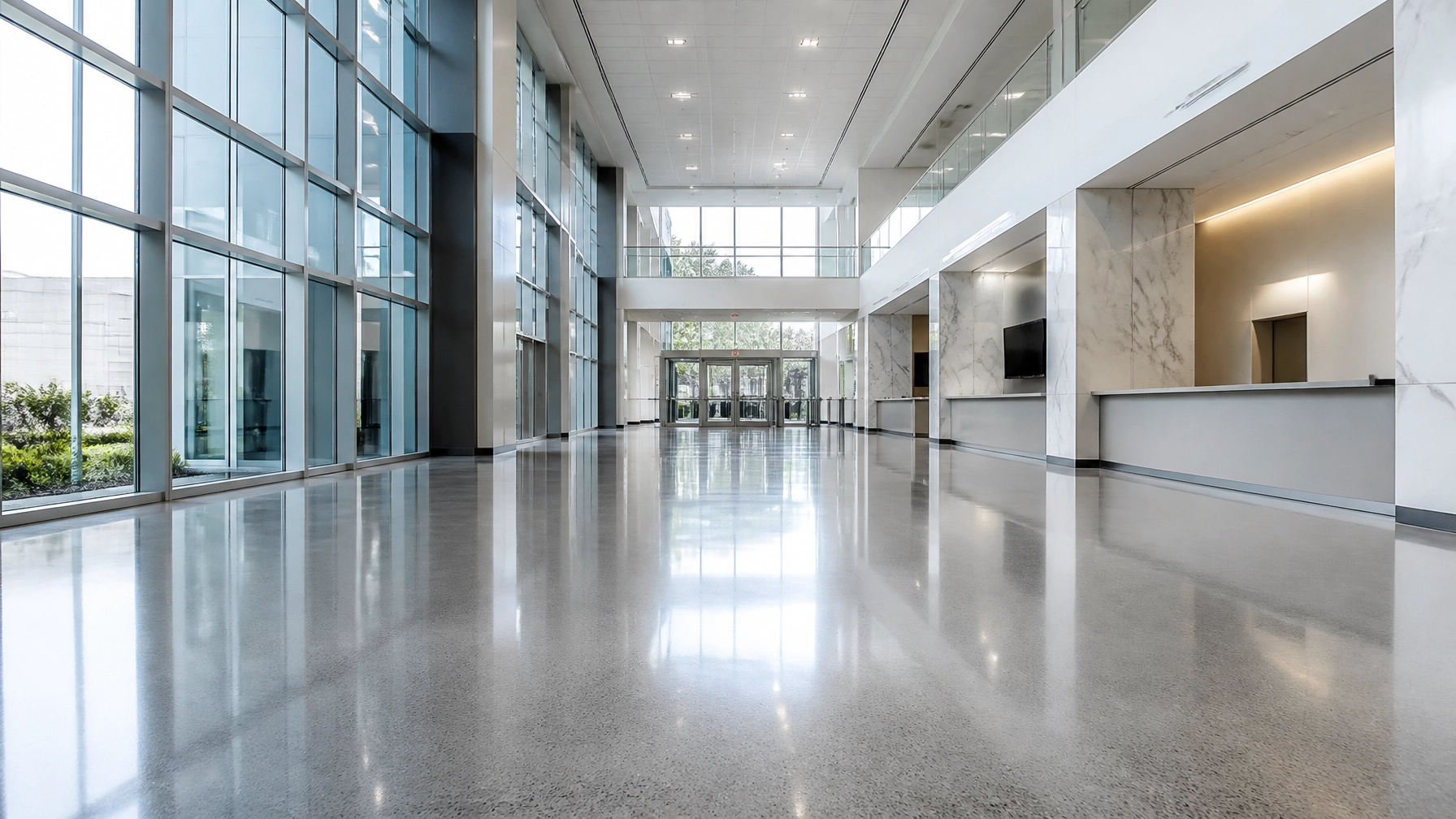
In the world of architectural finishes, few surfaces are as misunderstood as polished concrete. Often categorized simply as an "industrial look," this flooring system is, in reality, a high-performance infrastructure choice that requires a strategic, consultant-led approach to succeed. At Showcase Finishing Systems, we view polished concrete not just as a product, but as a conversation about fit: matching the specific conditions of your substrate to the operational demands of your space.
Whether you are managing a 50,000-square-foot commercial facility or upgrading a modern residential interior, the decision to choose polished concrete should be dictated by site-specific technical realities rather than aesthetic trends alone.
Slowing Down to Speed Up: The Diagnostic Phase
Before selecting a finish level or aggregate exposure, a professional evaluation must address the foundational state of the environment. Many projects fail because stakeholders rush into selecting a gloss level before understanding the "canvas": the existing concrete slab.
A "slow down to speed up" philosophy ensures that the system specified today remains functional for decades. Consider these critical diagnostic questions:
- What is the current moisture vapor emission rate (MVER)? Even though polished concrete is more breathable than non-permeable systems, excessive moisture can still impact certain densifiers or the structural integrity of the slab.
- What is the slab’s PSI? Soft concrete will accept densifiers differently than high-strength mixes, affecting the final "return-to-service" timeline and durability.
- Is the slab flat or wavy? Mechanical grinding can level minor imperfections, but severe "birdbaths" or high spots will result in uneven aggregate exposure.
- What was the previous floor covering? Residue from carpet glue, tile thin-set, or old epoxy can penetrate the pores of the concrete, requiring deeper grinding to reach "clean" stone.
By addressing these "hidden" issues upfront, we move from guesswork to a methodical installation plan.
The Technical Reality: How Polished Concrete Works
Polished concrete is not a coating. Unlike epoxy or urethane systems that sit on top of the substrate, polished concrete is a mechanical refinement of the slab itself. The process involves a sequence of diamond-impregnated abrasives that progressively "hone" the surface to a specific smoothness.
1. Substrate Preparation and Grinding
The initial stages involve "opening" the concrete surface. We use heavy-duty planetary grinders to remove surface contaminants and achieve the desired level of aggregate exposure: ranging from a "cream finish" (minimal stone showing) to a "large aggregate exposure" (mimicking the look of terrazzo).
2. Chemical Densification
This is the most critical technical step. We apply a chemical densifier: typically a lithium or silicate-based solution from premium suppliers like MAPEI or Sherwin-Williams. This liquid penetrates the concrete and reacts with the calcium hydroxide to create calcium silicate hydrate (CSH), essentially "closing" the pores and hardening the wear layer from within.
3. Refinement and Polishing
Once the slab is densified, we proceed through higher grit levels. Each pass further tightens the surface, increasing light reflectivity and abrasion resistance.

Day One vs. After Turnover: The Long-Term Ownership Mindset
Many flooring choices look exceptional on "Day One." However, the true value of a system is measured "After Turnover": six months, two years, or a decade into operation.
- Day One: Polished concrete offers an immediate, high-end aesthetic with no drying time associated with liquid-applied coatings. The space is often ready for foot traffic almost immediately after the final guard is applied.
- After Turnover: While a carpeted or tiled floor begins a cycle of degradation (staining, grout cracking, fiber wear), a polished concrete floor remains structurally stable. It does not require stripping, waxing, or deep chemical scrubbing. The "cost of ownership" is found in the absence of these recurring maintenance cycles.
Comparative Analysis of Systems
| Feature | Polished Concrete | VCT / Tile | Standard Epoxy |
|---|---|---|---|
| Primary Advantage | Lifecycle Durability | Low Initial Complexity | Chemical Resistance |
| Breathability | High (Vapor Permeable) | Low (Traps Moisture) | Very Low (Impermeable) |
| Maintenance | Dust Mop & Water | Waxing & Stripping | Periodic Re-coating |
| Environmental Impact | Sustainable (Existing Slab) | High (Material Waste) | Chemical Intensive |
Strategic Benefits for Commercial and Industrial Facilities
For facility managers and architects, the decision to specify polished concrete in industrial settings is often driven by three technical pillars: light reflectivity, durability, and hygiene.
Light Reflectivity and Energy Performance
In large-scale warehouses or retail showrooms, lighting accounts for a significant portion of operational expenses. Polished concrete's high specular highlights can increase ambient light by up to 30%. This allows for fewer light fixtures or lower-wattage lamps, contributing to long-term energy savings and a safer, more visible workspace for employees.

Durability Under Load
In environments with heavy forklift traffic or pallet jacks, floor coatings can delaminate under "point loading" or shear stress. Because polished concrete is the slab itself, there is no film to peel. The densified surface resists tire marks and abrasion far better than untreated concrete or thin-film coatings.
Residential Application: A Modern, Healthy Infrastructure
For the homeowner, polished concrete is a move toward minimalism and health. Unlike carpets that harbor allergens or wood floors that require sanding and refinishing, polished concrete is a seamless, inert surface.
- Hypoallergenic: The lack of fibers and grout lines means dust mites and mold have no place to reside.
- Thermal Mass: Concrete is an excellent thermal conductor. When paired with radiant floor heating, it provides a highly efficient and comfortable heating solution.
- Pet-Friendly: The hardened surface is exceptionally resistant to scratches from claws and is easily sanitized after accidents.
Maintenance: Protecting Your Investment
We treat post-installation maintenance with the same gravity as the installation itself. A polished concrete floor is low-maintenance, but it is not "no-maintenance." To ensure the floor performs as expected after turnover, we recommend a methodical approach:
- Dust Mopping: Routine removal of abrasive fine dust prevents the microscopic scratching that can dull the gloss over time.
- pH-Neutral Cleaners: Avoid acidic or highly alkaline cleaners that can chemically etch the surface.
- Automatic Scrubbers: For large commercial spaces, using a scrubber with non-aggressive pads and clean water is the industry standard for maintaining the "Day One" shine.
- Re-guarding: Depending on traffic volume, a topical "guard" or sealer may need to be burnished or reapplied every few years to maintain maximum stain resistance.

Conclusion: A Collaborative Partnership
Choosing the right flooring is a strategic decision that impacts the safety, efficiency, and aesthetic of your property for years to come. At Showcase Finishing Systems, we don't just provide a service; we act as collaborative partners in your project. We prioritize technical honesty, addressing the realities of your substrate and the needs of your operation before a single diamond pad touches the floor.
If you are ready to discuss how polished concrete can fit into your next project, reach out to our team for a diagnostic evaluation.