
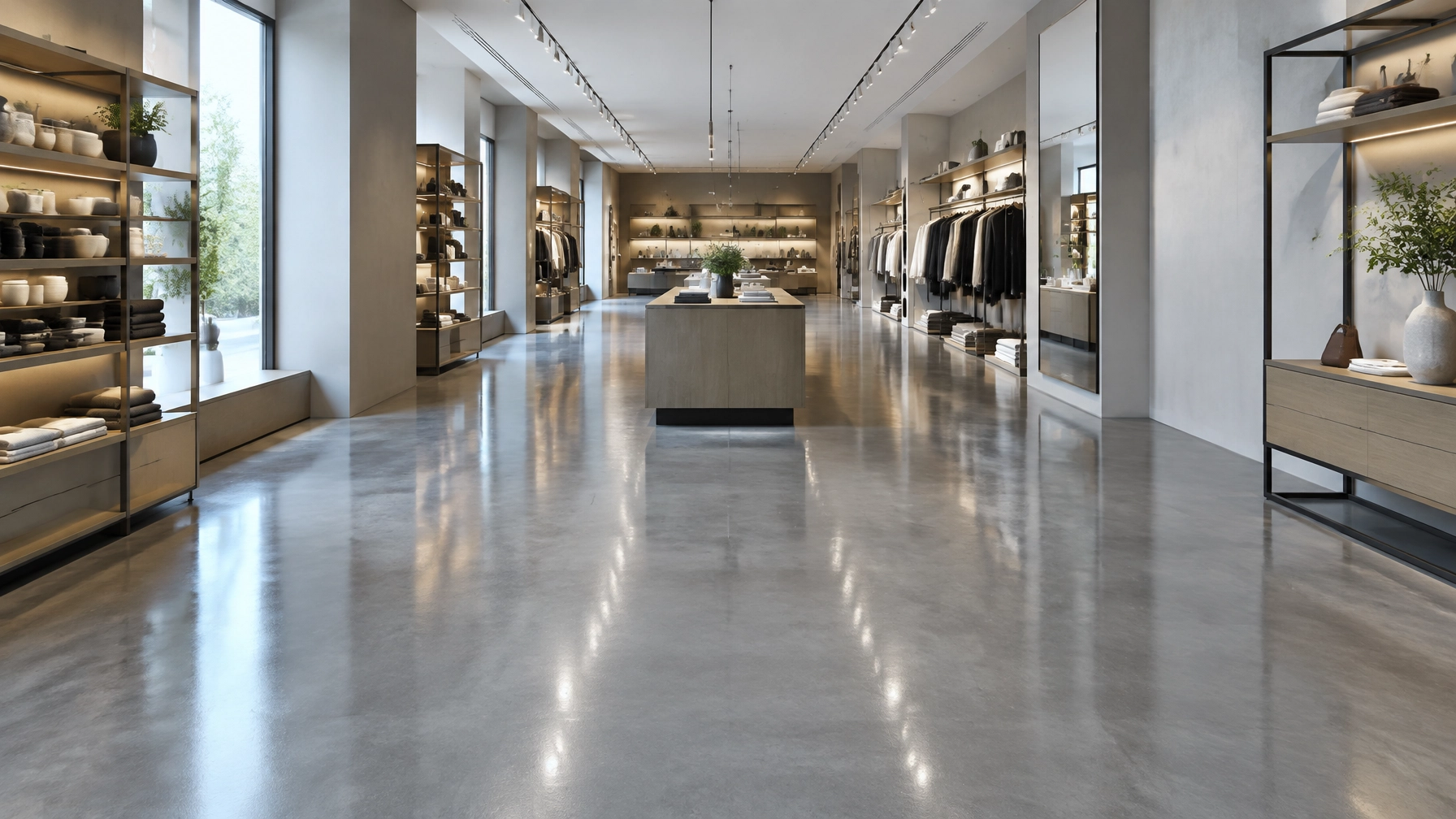
Choosing retail floor covering is a conversation about fit, not a contest to name one universally best material. Daily foot traffic, rolling displays, tracked-in water, cleaning routines, the condition of the slab, and the time available for renovation all shape the right choice.
A floor can look sharp on day one and still disappoint after turnover if moisture, cracks, or movement were overlooked. For retail store owners, facility managers, and project teams, the practical starting point is to understand the space and its demands before comparing finishes.
Showcase Finishing Systems works with commercial clients to evaluate and install systems such as polished concrete, epoxy resinous flooring, tile, and polishable overlays. The goal is to match the floor to the building, the brand, and the way the store operates.
Start with the conditions beneath the finish
Before choosing a color, gloss level, or tile pattern, slow down to answer the foundational questions. Retail traffic is more than the number of customers entering the store. Shopping carts, delivery dollies, display changes, entrance grit, and repeated cleaning all influence wear.
Review the following with your project team:
- What does each zone experience? A sales floor, entrance, fitting-room corridor, stockroom, and restroom may have different moisture, traffic, and cleaning requirements.
- What is the substrate condition? Look for cracking, weak or contaminated concrete, old coatings, unevenness, and previous patching.
- Is moisture present or anticipated? Moisture moving through a slab can compromise some flooring systems, so testing and manufacturer limits matter before specifying an impermeable finish.
- Which joints move? Structural and other moving joints need appropriate detailing. Covering them rigidly can transfer movement into the finished floor.
- What does the maintenance program require? Consider staff capacity, equipment, approved cleaning products, and the appearance standard expected after opening.
- How will the work be sequenced? Store hours, deliveries, phased access, cure time, and planned return-to-service all affect the installation approach.
These questions are especially important in renovations. A building’s age, exposure to seasonal weather, and history of spills or repairs can matter as much as the intended design.
Three retail floor covering options to compare
Polished concrete: a finish that works with the slab
Polished concrete uses the concrete slab itself as the finished surface. Where the slab is suitable, it can provide a continuous appearance with no tile grout lines and a finish that works across large retail areas. Color and aggregate variation, however, are part of the material’s character. Existing cracks, repairs, and slab differences may remain visible.
This system is worth considering when the slab’s condition and appearance align with the design intent, and when the owner wants to avoid installing a separate floor covering. Routine care typically includes removing grit, cleaning spills promptly, and following a surface-appropriate cleaning and maintenance plan. The required upkeep depends on the system and the standard of appearance the owner wants to maintain.
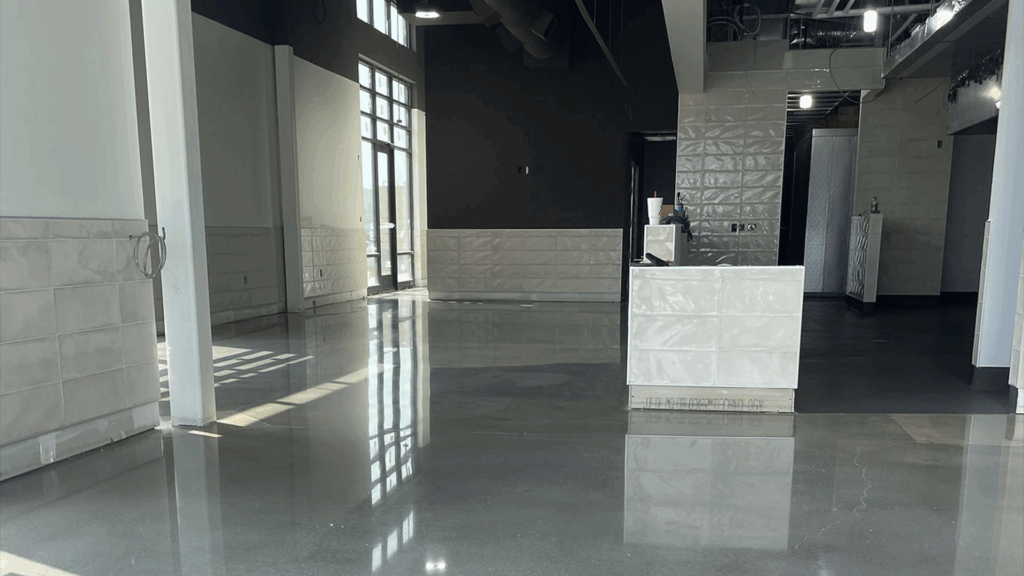
A polishable overlay may be another option if the existing slab is not an appropriate finished surface. An overlay is a separate system, and it still depends on careful substrate evaluation and preparation. Showcase completed a polished overlay project at Honeygrow Restaurant, where the floor was paired with glass wall tile in a contemporary commercial interior.
Epoxy and resinous flooring: continuous surfaces with system-specific performance
Epoxy resinous flooring can create a continuous, easy-to-clean surface and is available in finishes suited to different commercial requirements. Depending on the selected system, it may be appropriate where abrasion, chemical exposure, controlled color, or a seamless finish is a priority. “Epoxy,” however, is not a complete specification: the system build, surface preparation, texture, and finish all influence how it performs.
Moisture is a key consideration. If vapor transmission or other moisture conditions exceed the limits for the chosen system, adhesion problems or other failures may follow. A site evaluation should identify what testing is needed, what the results mean for the proposed system, and whether manufacturer-approved mitigation is required. Cracks and moving joints also need to be addressed; a resin coating should not be assumed to stabilize an active joint.
Ask the project team to document the surface preparation, moisture requirements, product layers, cure conditions, texture, and expected return-to-service. Showcase’s epoxy and resinous flooring services can be evaluated alongside polished concrete and tile rather than treated as the default answer for every retail space.
Tile: design control and localized replacement
Tile offers flexibility in format, pattern, color, and transitions. It can be a strong fit for retail zones where the design calls for a more articulated finish, and it can help coordinate floors with bathroom finishes or decorative wall tile. Damaged pieces may be replaceable locally, although the match can depend on the product, availability, and how the original installation has aged.
The tile surface is only one part of the assembly. Substrate stability, flatness, setting materials, grout, transitions, and movement joints all affect the result. Grout also adds cleaning and maintenance requirements. In restrooms and other areas exposed to water, the assembly and slip characteristics should be selected for the actual conditions, not inferred from appearance alone.
Movement joints need particular attention. Tile and grout should not be used to conceal or rigidly bridge joints that are meant to accommodate movement. The Tile Council of North America provides industry guidance, including movement-joint considerations, that project teams can use when coordinating tile details.

For examples of commercial tile detailing, see Showcase’s completed Dear Daphni Restaurant project. While each site has different requirements, the project illustrates how tile and stone finishes can contribute to a coordinated commercial interior. Showcase also installs commercial and residential tile flooring and wall tile and wainscot, which can help connect floor and wall finishes in retail restrooms and other areas.
Common mistakes that undermine a good-looking floor
A product selected without reviewing the site can create problems that only become apparent after the store reopens. Avoid these common missteps:
- Selecting by sample alone. A small sample does not reveal how an entire floor will look under the store’s lighting or how it will wear in its busiest paths.
- Treating every crack the same way. Stable cracks, repairs, and moving joints call for different evaluations and details.
- Ignoring moisture testing. A clean-looking slab is not proof that it meets a flooring system’s moisture requirements.
- Choosing gloss without considering safety and maintenance. Surface appearance, traction, light reflection, and cleaning methods should be considered together.
- Underestimating sequencing. Cure time, access, fixture moves, and protection requirements affect whether a floor can meet the store’s reopening plan.
- Leaving maintenance until after turnover. If the care plan is unclear, even a suitable floor may lose the appearance the owner intended.
Plan installation and maintenance together
Once a system is selected, coordinate preparation, installation, protection, and reopening as one plan. Confirm substrate repairs and testing, preserve required movement joints, and use compatible materials throughout the assembly. Where possible, review a representative mock-up under the store’s lighting before approving the final appearance.
Return-to-service is system- and site-specific. Temperature, humidity, substrate conditions, product requirements, and the scope of preparation all influence the schedule. The manufacturer’s current installation guidance should inform when foot traffic, fixtures, and routine cleaning can resume.
After turnover, protect the floor with an agreed maintenance program. Use the cleaning products and equipment appropriate to the installed system, remove abrasive grit regularly, and address spills promptly. Schedule periodic inspections for worn finishes, damaged grout, failed sealants, or areas that need repair. A maintenance plan is not an afterthought; it is part of long-term floor performance.
A practical way to choose
Polished concrete may fit a suitable slab and a design that accepts its natural variation. Epoxy may suit a project that needs a continuous resinous system and can meet its preparation and moisture requirements. Tile may be the right choice where layout, material detail, or repairability is important, and where the assembly can be properly supported and maintained.
Showcase Finishing Systems helps commercial and residential clients compare these options against actual conditions, including the substrate, traffic, maintenance expectations, and operational schedule. Explore the retail flooring industry page or contact Showcase to discuss your space before settling on a system.